The real risk is not the model
Incidents come from wiring — shared logins, keys in spreadsheets, and PII in public chat — not from picking the wrong LLM.
Headlines obsess over model benchmarks; most business incidents come from how AI is wired in. Shared logins, API keys in spreadsheets, and copying client data into consumer chat tools create audit gaps you cannot close later.
EZ4Youtech treats security as architecture: JWT-scoped APIs, tenant isolation, Fernet-encrypted BYOK credentials, and documents in tenant-prefixed paths. No API key material in application logs.
SMB leaders without a full-time CISO still face carrier questionnaires, state privacy rules, and client contracts that ask where inference runs. A credible baseline beats a perfect model choice.
SMB security is mostly operational: who can log in, where files rest, and whether client data trains public models. Architecture answers those questions without hiring a full SOC.
Carrier questionnaires often copy enterprise templates — tenant isolation and BYOK let you respond with specifics instead of 'we use AI responsibly' platitudes.
Security maturity for SMBs is repeating the basics at scale: unique users, encrypted credentials, scoped storage, reviewed outbound comms. Fancy model choice does not replace those habits.
When a client asks 'where is our data,' point to tenant prefixing and provider consoles — not a generic 'we use enterprise AI' slide.
Shadow AI dies when the approved workspace is faster than consumer chat — invest in tuned apps and training, not prohibition memos alone.
SMB security reviews in 2026 focus on wiring: JWT users, encrypted BYOK credentials, tenant-prefixed files, and human review on regulated sends. Point reviewers to architecture-security and your provider retention settings — the combination beats a generic 'we use AI' statement in carrier packets.
Share this article with stakeholders who still conflate consumer chat with business AI — EZ4Youtech combines BYOK, tenant isolation, plan-gated catalog apps, and partner-friendly economics so pilots convert to Standard with evidence, not enthusiasm alone.
Leaders evaluating EZ4Youtech should ask for a thirty-day pilot on Basic: connect BYOK, run one catalog app on live (redacted) work, and compare handle time and edit distance to baseline. That evidence converts stakeholders faster than feature tours — and sets up Standard seat expansion when a second agent needs the same apps daily.

Baseline controls you can implement this quarter
You do not need a twenty-page policy to start. Implement customer-managed keys, separate admin from agent roles, and require human approval on regulated outbound content.
Incident response improves when run history is per-tenant: you know which user ran which app on which document instead of searching a shared chat thread.
Elite-tier compliance apps are optional accelerators; the baseline security story is the same on Basic because BYOK and isolation are platform-wide.
Renewals with carriers get smoother when you document human-review SOPs alongside architecture links — process plus platform beats platform alone.
Security maturity for SMBs is repeating the basics at scale: unique users, encrypted credentials, scoped storage, reviewed outbound comms. Fancy model choice does not replace those habits.
When a client asks 'where is our data,' point to tenant prefixing and provider consoles — not a generic 'we use enterprise AI' slide.
SMB security reviews in 2026 focus on wiring: JWT users, encrypted BYOK credentials, tenant-prefixed files, and human review on regulated sends. Point reviewers to architecture-security and your provider retention settings — the combination beats a generic 'we use AI' statement in carrier packets.
Share this article with stakeholders who still conflate consumer chat with business AI — EZ4Youtech combines BYOK, tenant isolation, plan-gated catalog apps, and partner-friendly economics so pilots convert to Standard with evidence, not enthusiasm alone.
Leaders evaluating EZ4Youtech should ask for a thirty-day pilot on Basic: connect BYOK, run one catalog app on live (redacted) work, and compare handle time and edit distance to baseline. That evidence converts stakeholders faster than feature tours — and sets up Standard seat expansion when a second agent needs the same apps daily.
- JWT-scoped APIs with
tenant_idon every request - Fernet-encrypted provider keys; decrypted only at runtime
- Documents in tenant-prefixed object storage paths
- Plan gating so users only open apps you purchased
- Seat limits aligned to subscription — no shadow users
| Control | EZ4Youtech BYOK | Shared team ChatGPT login |
|---|---|---|
| Key custody | Customer provider account | Opaque / shared |
| Per-user audit | JWT users + run history | Weak or none |
| Training policy | Your provider console | Unclear on free tiers |
| Cost visibility | Provider dashboard | Hidden in subscription |
Upload real files — inside a boundary you trust
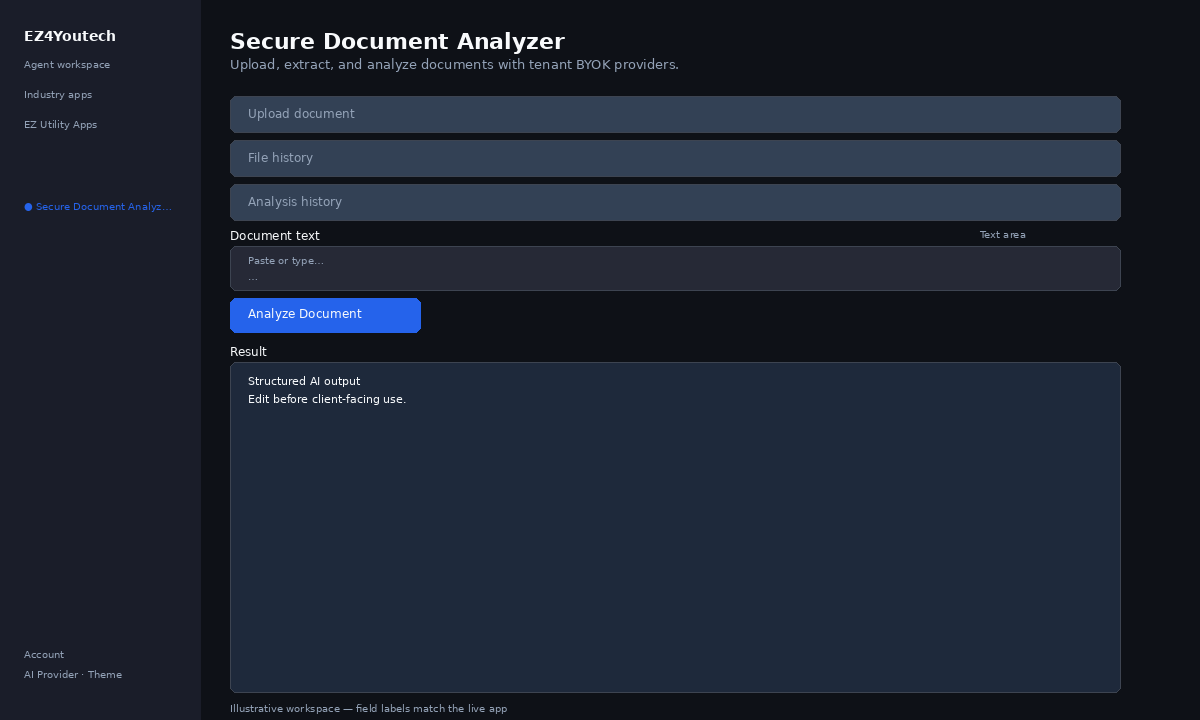
Teams that trust the boundary move faster: they upload contracts, policies, and customer threads inside Secure Document Analyzer instead of sanitizing everything for a consumer chatbot.
Structured fields reduce accidental paste of account numbers into free-form threads. Reviewers see what left the tenant and who approved it.
SMB security is mostly operational: who can log in, where files rest, and whether client data trains public models. Architecture answers those questions without hiring a full SOC.
Carrier questionnaires often copy enterprise templates — tenant isolation and BYOK let you respond with specifics instead of 'we use AI responsibly' platitudes.
Shadow AI dies when the approved workspace is faster than consumer chat — invest in tuned apps and training, not prohibition memos alone.
Renewals with carriers get smoother when you document human-review SOPs alongside architecture links — process plus platform beats platform alone.
Security maturity for SMBs is repeating the basics at scale: unique users, encrypted credentials, scoped storage, reviewed outbound comms. Fancy model choice does not replace those habits.
SMB security reviews in 2026 focus on wiring: JWT users, encrypted BYOK credentials, tenant-prefixed files, and human review on regulated sends. Point reviewers to architecture-security and your provider retention settings — the combination beats a generic 'we use AI' statement in carrier packets.
Share this article with stakeholders who still conflate consumer chat with business AI — EZ4Youtech combines BYOK, tenant isolation, plan-gated catalog apps, and partner-friendly economics so pilots convert to Standard with evidence, not enthusiasm alone.
Leaders evaluating EZ4Youtech should ask for a thirty-day pilot on Basic: connect BYOK, run one catalog app on live (redacted) work, and compare handle time and edit distance to baseline. That evidence converts stakeholders faster than feature tours — and sets up Standard seat expansion when a second agent needs the same apps daily.
Multi-tenant isolation in plain language
Each client organization is a tenant. Users, documents, run history, and encrypted keys do not cross tenant boundaries. Partners who refer business provision tenants; they do not own your customer data.
This model maps to how SMBs already think about client files: Agency A never sees Agency B’s uploads — even when both buy the same platform SKU.
Incident response improves when run history is per-tenant: you know which user ran which app on which document instead of searching a shared chat thread.
Elite-tier compliance apps are optional accelerators; the baseline security story is the same on Basic because BYOK and isolation are platform-wide.
When a client asks 'where is our data,' point to tenant prefixing and provider consoles — not a generic 'we use enterprise AI' slide.
Shadow AI dies when the approved workspace is faster than consumer chat — invest in tuned apps and training, not prohibition memos alone.
Renewals with carriers get smoother when you document human-review SOPs alongside architecture links — process plus platform beats platform alone.
SMB security reviews in 2026 focus on wiring: JWT users, encrypted BYOK credentials, tenant-prefixed files, and human review on regulated sends. Point reviewers to architecture-security and your provider retention settings — the combination beats a generic 'we use AI' statement in carrier packets.
Share this article with stakeholders who still conflate consumer chat with business AI — EZ4Youtech combines BYOK, tenant isolation, plan-gated catalog apps, and partner-friendly economics so pilots convert to Standard with evidence, not enthusiasm alone.
Leaders evaluating EZ4Youtech should ask for a thirty-day pilot on Basic: connect BYOK, run one catalog app on live (redacted) work, and compare handle time and edit distance to baseline. That evidence converts stakeholders faster than feature tours — and sets up Standard seat expansion when a second agent needs the same apps daily.


Security enables speed — here is the proof pattern
Counterintuitively, teams with clear boundaries adopt AI faster. They stop maintaining shadow tools because the approved workspace handles real workloads.
Measure adoption by approved runs per week, not by how many employees opened a consumer chat tab.
SMB security is mostly operational: who can log in, where files rest, and whether client data trains public models. Architecture answers those questions without hiring a full SOC.
Carrier questionnaires often copy enterprise templates — tenant isolation and BYOK let you respond with specifics instead of 'we use AI responsibly' platitudes.
Security maturity for SMBs is repeating the basics at scale: unique users, encrypted credentials, scoped storage, reviewed outbound comms. Fancy model choice does not replace those habits.
When a client asks 'where is our data,' point to tenant prefixing and provider consoles — not a generic 'we use enterprise AI' slide.
Shadow AI dies when the approved workspace is faster than consumer chat — invest in tuned apps and training, not prohibition memos alone.
SMB security reviews in 2026 focus on wiring: JWT users, encrypted BYOK credentials, tenant-prefixed files, and human review on regulated sends. Point reviewers to architecture-security and your provider retention settings — the combination beats a generic 'we use AI' statement in carrier packets.
Share this article with stakeholders who still conflate consumer chat with business AI — EZ4Youtech combines BYOK, tenant isolation, plan-gated catalog apps, and partner-friendly economics so pilots convert to Standard with evidence, not enthusiasm alone.
Leaders evaluating EZ4Youtech should ask for a thirty-day pilot on Basic: connect BYOK, run one catalog app on live (redacted) work, and compare handle time and edit distance to baseline. That evidence converts stakeholders faster than feature tours — and sets up Standard seat expansion when a second agent needs the same apps daily.
Security is not the brake on AI — it is the reason your best operators will finally stop using three unofficial tools.
EZ4Youtech security overview
Adoption vs perceived risk (illustrative)
Vendor due diligence questions — answered
Incident response improves when run history is per-tenant: you know which user ran which app on which document instead of searching a shared chat thread.
Elite-tier compliance apps are optional accelerators; the baseline security story is the same on Basic because BYOK and isolation are platform-wide.
Renewals with carriers get smoother when you document human-review SOPs alongside architecture links — process plus platform beats platform alone.
Security maturity for SMBs is repeating the basics at scale: unique users, encrypted credentials, scoped storage, reviewed outbound comms. Fancy model choice does not replace those habits.
When a client asks 'where is our data,' point to tenant prefixing and provider consoles — not a generic 'we use enterprise AI' slide.
SMB security reviews in 2026 focus on wiring: JWT users, encrypted BYOK credentials, tenant-prefixed files, and human review on regulated sends. Point reviewers to architecture-security and your provider retention settings — the combination beats a generic 'we use AI' statement in carrier packets.
Share this article with stakeholders who still conflate consumer chat with business AI — EZ4Youtech combines BYOK, tenant isolation, plan-gated catalog apps, and partner-friendly economics so pilots convert to Standard with evidence, not enthusiasm alone.
Leaders evaluating EZ4Youtech should ask for a thirty-day pilot on Basic: connect BYOK, run one catalog app on live (redacted) work, and compare handle time and edit distance to baseline. That evidence converts stakeholders faster than feature tours — and sets up Standard seat expansion when a second agent needs the same apps daily.
Where do prompts and files go?
Inference routes to the provider configured in BYOK. Files remain in tenant-scoped storage; EZ4Youtech does not sell your documents to train public models.
Who can decrypt API keys?
Runtime services decrypt for routing only; keys are not echoed to users or logs. Rotation is an admin action.
Incident patterns to avoid
SMB security is mostly operational: who can log in, where files rest, and whether client data trains public models. Architecture answers those questions without hiring a full SOC.
Carrier questionnaires often copy enterprise templates — tenant isolation and BYOK let you respond with specifics instead of 'we use AI responsibly' platitudes.
Shadow AI dies when the approved workspace is faster than consumer chat — invest in tuned apps and training, not prohibition memos alone.
Renewals with carriers get smoother when you document human-review SOPs alongside architecture links — process plus platform beats platform alone.
Security maturity for SMBs is repeating the basics at scale: unique users, encrypted credentials, scoped storage, reviewed outbound comms. Fancy model choice does not replace those habits.
SMB security reviews in 2026 focus on wiring: JWT users, encrypted BYOK credentials, tenant-prefixed files, and human review on regulated sends. Point reviewers to architecture-security and your provider retention settings — the combination beats a generic 'we use AI' statement in carrier packets.
Share this article with stakeholders who still conflate consumer chat with business AI — EZ4Youtech combines BYOK, tenant isolation, plan-gated catalog apps, and partner-friendly economics so pilots convert to Standard with evidence, not enthusiasm alone.
Leaders evaluating EZ4Youtech should ask for a thirty-day pilot on Basic: connect BYOK, run one catalog app on live (redacted) work, and compare handle time and edit distance to baseline. That evidence converts stakeholders faster than feature tours — and sets up Standard seat expansion when a second agent needs the same apps daily.
- One shared password for five producers — no attribution when data leaks
- Pasting full SSN or policy numbers into free tiers with unclear retention
- Treating model output as final on regulated client communications
- Skipping seat limits — former employees still “using AI” on a shared login
Roll security forward with your plan tier
Basic pilots prove one secure workflow. Standard spreads the same boundary to five agents. Elite adds compliance-oriented utility apps when legal wants automated checks on generated text.
Enterprise custom integrations stay in SOW scope — the shared platform still enforces tenant isolation for daily agent work.
Incident response improves when run history is per-tenant: you know which user ran which app on which document instead of searching a shared chat thread.
Elite-tier compliance apps are optional accelerators; the baseline security story is the same on Basic because BYOK and isolation are platform-wide.
When a client asks 'where is our data,' point to tenant prefixing and provider consoles — not a generic 'we use enterprise AI' slide.
Shadow AI dies when the approved workspace is faster than consumer chat — invest in tuned apps and training, not prohibition memos alone.
Renewals with carriers get smoother when you document human-review SOPs alongside architecture links — process plus platform beats platform alone.
SMB security reviews in 2026 focus on wiring: JWT users, encrypted BYOK credentials, tenant-prefixed files, and human review on regulated sends. Point reviewers to architecture-security and your provider retention settings — the combination beats a generic 'we use AI' statement in carrier packets.
Share this article with stakeholders who still conflate consumer chat with business AI — EZ4Youtech combines BYOK, tenant isolation, plan-gated catalog apps, and partner-friendly economics so pilots convert to Standard with evidence, not enthusiasm alone.
Leaders evaluating EZ4Youtech should ask for a thirty-day pilot on Basic: connect BYOK, run one catalog app on live (redacted) work, and compare handle time and edit distance to baseline. That evidence converts stakeholders faster than feature tours — and sets up Standard seat expansion when a second agent needs the same apps daily.
Next step
Ready to move from reading to doing? Start with a pilot or talk to our team.