Why BYOK matters in 2026
Consumer AI optimized for individuals; regulated businesses need tenant boundaries and customer-managed keys.
Bring Your Own Key (BYOK) means your organization connects your paid API account to the workflow platform. EZ4Youtech stores credentials encrypted per tenant with Fernet; users never paste secrets into chat windows or shared spreadsheets.
When a vendor pools AI access behind one opaque key, you lose visibility into token spend, training posture, and who decrypted credentials last Tuesday. BYOK restores that visibility because OpenAI, Together, or Anyscale bill your account directly.
Business teams need audit-friendly boundaries: which tenant owns uploaded policies, whether prompts can train public models, and which role configured provider keys. Tenant admins hold BYOK setup; users run tuned utility and industry apps inside JWT-scoped workspaces.
EZ4Youtech charges a platform subscription separately — no token markup in the BYOK model. Finance sees platform fees on one invoice and provider usage on the dashboards you already trust.
Procurement teams increasingly ask for a data-flow diagram before renewal. BYOK gives you a crisp story: credentials encrypted per tenant, inference on your provider account, documents in tenant-prefixed storage, and users working through catalog apps instead of ad-hoc paste.
If you operate across insurance, real estate, or legal, your clients already assume you control subprocessors. Showing customer-managed keys and plan-gated apps is faster than negotiating a new vendor DPA for an opaque shared pool.
Think of BYOK as extending the same trust model you already use for email and document storage: the business owns the account, assigns users, and can prove who accessed what. EZ4Youtech applies that pattern to inference — your OpenAI, Together, or Anyscale relationship stays primary; the platform orchestrates apps and isolation without reselling tokens.
For LinkedIn or partner webinars, the crisp message is: customer-managed keys, tenant-scoped files, forty-five tuned apps, plan-based seats. That quartet answers most SMB security questionnaires without a custom security whitepaper per client.
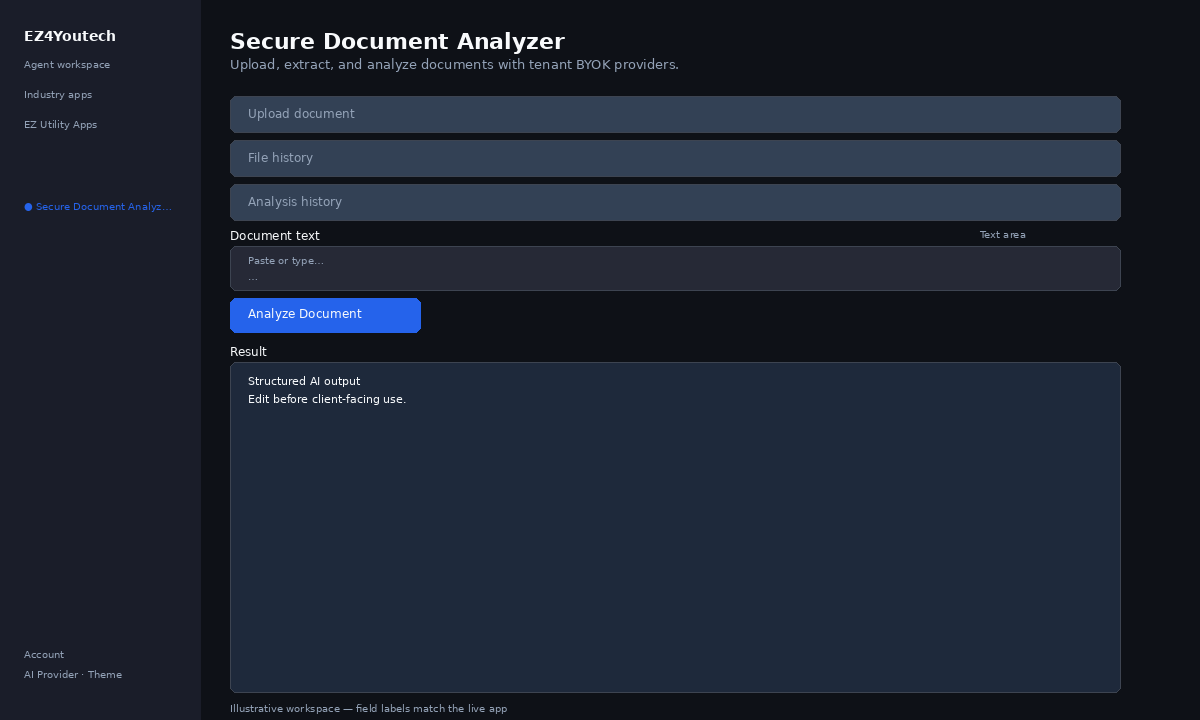
Agents experience BYOK as invisible infrastructure. They open Document Analyzer or Policy Explainer, submit structured inputs, and receive drafts — admins already connected keys. Adoption rises because the secure path is also the easy path.
- You control training and retention in your provider console
- Encrypted keys per tenant; decrypted only at runtime for routing
- 45 catalog apps share the same secure boundary — not 45 one-off integrations

Architecture your security reviewer will recognize
Security is not a checkbox on a marketing page — it is how requests flow. Every API call carries tenant_id from JWT context. Documents land in tenant-prefixed storage paths; run history stays inside that scope.
The AI router selects among configured providers without logging key material. Failover routes high-priority apps to a backup key when a vendor has an outage — without asking users to swap tools.
Training policy belongs in the provider console you already monitor. EZ4Youtech does not resell tokens or blend usage into an unreadable platform line — finance can reconcile platform subscription and inference separately every month.
When an employee leaves, disable their JWT user — do not rotate the entire team's consumer chat password. Seat limits on Basic, Standard, and Elite exist so subscription matches real headcount, not shadow logins.
When you compare annual platform spend to hours recovered on intake and summaries, BYOK pilots often pay back before you need Elite features — especially on Basic with one seat and a single measurable queue.
Think of BYOK as extending the same trust model you already use for email and document storage: the business owns the account, assigns users, and can prove who accessed what. EZ4Youtech applies that pattern to inference — your OpenAI, Together, or Anyscale relationship stays primary; the platform orchestrates apps and isolation without reselling tokens.
For LinkedIn or partner webinars, the crisp message is: customer-managed keys, tenant-scoped files, forty-five tuned apps, plan-based seats. That quartet answers most SMB security questionnaires without a custom security whitepaper per client.
Credential lifecycle
Tenant admins save keys once in the credentials screen. Rotation means update the admin record — users keep working in Document Analyzer, Policy Explainer, and industry packs without re-sharing secrets.
- No API keys in application logs or support transcripts
- Plan gating limits which apps users can open
- Seat limits match subscription to real headcount
Document handling
Uploads for contracts, policies, and intake forms stay in tenant scope. That is why teams trust the boundary enough to stop sanitizing every field for a consumer chatbot.



Start with one workflow that touches real client data
Secure adoption does not mean boiling the ocean. Pick document intake, policy summary, or contract review — a workflow where generic chat already feels risky. Provision a pilot tenant on Basic, connect BYOK, and measure time saved for two weeks before expanding seats.
Run history and uploads stay in your tenant scope on EZ4Youtech, not as a permanent transcript on a consumer product with unclear retention.
Human review remains mandatory for client-facing insurance, legal, and pharmacy communications. AI accelerates drafts; your team approves what ships.
Procurement teams increasingly ask for a data-flow diagram before renewal. BYOK gives you a crisp story: credentials encrypted per tenant, inference on your provider account, documents in tenant-prefixed storage, and users working through catalog apps instead of ad-hoc paste.
If you operate across insurance, real estate, or legal, your clients already assume you control subprocessors. Showing customer-managed keys and plan-gated apps is faster than negotiating a new vendor DPA for an opaque shared pool.
Agents experience BYOK as invisible infrastructure. They open Document Analyzer or Policy Explainer, submit structured inputs, and receive drafts — admins already connected keys. Adoption rises because the secure path is also the easy path.
When you compare annual platform spend to hours recovered on intake and summaries, BYOK pilots often pay back before you need Elite features — especially on Basic with one seat and a single measurable queue.
Think of BYOK as extending the same trust model you already use for email and document storage: the business owns the account, assigns users, and can prove who accessed what. EZ4Youtech applies that pattern to inference — your OpenAI, Together, or Anyscale relationship stays primary; the platform orchestrates apps and isolation without reselling tokens.
BYOK vs “just use ChatGPT”
Shared consumer logins create silent risk: no per-user audit trail, unclear training policy, and client PII in threads that outlive the employee who pasted them. Procurement and carrier due diligence increasingly ask where data goes — BYOK plus tenant isolation answers with architecture, not promises.
Training policy belongs in the provider console you already monitor. EZ4Youtech does not resell tokens or blend usage into an unreadable platform line — finance can reconcile platform subscription and inference separately every month.
When an employee leaves, disable their JWT user — do not rotate the entire team's consumer chat password. Seat limits on Basic, Standard, and Elite exist so subscription matches real headcount, not shadow logins.
For LinkedIn or partner webinars, the crisp message is: customer-managed keys, tenant-scoped files, forty-five tuned apps, plan-based seats. That quartet answers most SMB security questionnaires without a custom security whitepaper per client.
Agents experience BYOK as invisible infrastructure. They open Document Analyzer or Policy Explainer, submit structured inputs, and receive drafts — admins already connected keys. Adoption rises because the secure path is also the easy path.
When you compare annual platform spend to hours recovered on intake and summaries, BYOK pilots often pay back before you need Elite features — especially on Basic with one seat and a single measurable queue.
The fastest teams are not the ones that skip security — they are the ones that trust the boundary enough to upload real files.
EZ4Youtech customer success pattern
Security posture comparison (illustrative)
Plans that match secure rollout stages
Basic ($39/mo platform + your BYOK usage) supports one user, two utility apps, and two industry apps — ideal for proving value on a single workflow.
Standard unlocks five users and a broader catalog for departmental rollout. Elite adds workflow builder, compliance checker, and financial assistant when ops and compliance share the same tenant.
Procurement teams increasingly ask for a data-flow diagram before renewal. BYOK gives you a crisp story: credentials encrypted per tenant, inference on your provider account, documents in tenant-prefixed storage, and users working through catalog apps instead of ad-hoc paste.
If you operate across insurance, real estate, or legal, your clients already assume you control subprocessors. Showing customer-managed keys and plan-gated apps is faster than negotiating a new vendor DPA for an opaque shared pool.
Think of BYOK as extending the same trust model you already use for email and document storage: the business owns the account, assigns users, and can prove who accessed what. EZ4Youtech applies that pattern to inference — your OpenAI, Together, or Anyscale relationship stays primary; the platform orchestrates apps and isolation without reselling tokens.
For LinkedIn or partner webinars, the crisp message is: customer-managed keys, tenant-scoped files, forty-five tuned apps, plan-based seats. That quartet answers most SMB security questionnaires without a custom security whitepaper per client.
Agents experience BYOK as invisible infrastructure. They open Document Analyzer or Policy Explainer, submit structured inputs, and receive drafts — admins already connected keys. Adoption rises because the secure path is also the easy path.

Partner and carrier conversations
Referral partners and carrier IT questionnaires ask the same questions: who holds keys, where files live, and whether users can exfiltrate secrets. Point reviewers to architecture-security documentation and your provider consoles for retention settings.
Because EZ4Youtech does not markup tokens in BYOK mode, partners can explain cost honestly: platform fee to EZ4Youtech, inference to the customer’s provider account.
Training policy belongs in the provider console you already monitor. EZ4Youtech does not resell tokens or blend usage into an unreadable platform line — finance can reconcile platform subscription and inference separately every month.
When an employee leaves, disable their JWT user — do not rotate the entire team's consumer chat password. Seat limits on Basic, Standard, and Elite exist so subscription matches real headcount, not shadow logins.
When you compare annual platform spend to hours recovered on intake and summaries, BYOK pilots often pay back before you need Elite features — especially on Basic with one seat and a single measurable queue.
Think of BYOK as extending the same trust model you already use for email and document storage: the business owns the account, assigns users, and can prove who accessed what. EZ4Youtech applies that pattern to inference — your OpenAI, Together, or Anyscale relationship stays primary; the platform orchestrates apps and isolation without reselling tokens.
For LinkedIn or partner webinars, the crisp message is: customer-managed keys, tenant-scoped files, forty-five tuned apps, plan-based seats. That quartet answers most SMB security questionnaires without a custom security whitepaper per client.

Operational habits that keep BYOK secure
Procurement teams increasingly ask for a data-flow diagram before renewal. BYOK gives you a crisp story: credentials encrypted per tenant, inference on your provider account, documents in tenant-prefixed storage, and users working through catalog apps instead of ad-hoc paste.
If you operate across insurance, real estate, or legal, your clients already assume you control subprocessors. Showing customer-managed keys and plan-gated apps is faster than negotiating a new vendor DPA for an opaque shared pool.
Agents experience BYOK as invisible infrastructure. They open Document Analyzer or Policy Explainer, submit structured inputs, and receive drafts — admins already connected keys. Adoption rises because the secure path is also the easy path.
When you compare annual platform spend to hours recovered on intake and summaries, BYOK pilots often pay back before you need Elite features — especially on Basic with one seat and a single measurable queue.
Think of BYOK as extending the same trust model you already use for email and document storage: the business owns the account, assigns users, and can prove who accessed what. EZ4Youtech applies that pattern to inference — your OpenAI, Together, or Anyscale relationship stays primary; the platform orchestrates apps and isolation without reselling tokens.
When to escalate to Enterprise
Custom CRM pipes, carrier APIs, or proprietary data feeds belong in a scoped SOW. The shared platform still runs day-to-day apps for users with the same tenant isolation model.
- Rotate provider keys on the same schedule as other API credentials
- Never share one ChatGPT login across five users — use users and JWT users instead
- Review usage monthly; spike in tokens often means a workflow needs tuning, not a new model
- Keep BYOK configuration in tenant admin hands; users should not hunt for secrets
What success looks like after 90 days
Teams that implement BYOK well stop maintaining parallel tools: consumer chat for brainstorming, inbox rules for drafts, and a spreadsheet of prompts nobody else can read. They run intake, summaries, and outreach inside one workspace with consistent tone and measurable handle time.
Security enables speed — not the other way around. When users trust the boundary, they upload real contracts and policies, get structured drafts back, and move deals forward with fewer round trips.
Training policy belongs in the provider console you already monitor. EZ4Youtech does not resell tokens or blend usage into an unreadable platform line — finance can reconcile platform subscription and inference separately every month.
When an employee leaves, disable their JWT user — do not rotate the entire team's consumer chat password. Seat limits on Basic, Standard, and Elite exist so subscription matches real headcount, not shadow logins.
For LinkedIn or partner webinars, the crisp message is: customer-managed keys, tenant-scoped files, forty-five tuned apps, plan-based seats. That quartet answers most SMB security questionnaires without a custom security whitepaper per client.
Agents experience BYOK as invisible infrastructure. They open Document Analyzer or Policy Explainer, submit structured inputs, and receive drafts — admins already connected keys. Adoption rises because the secure path is also the easy path.
When you compare annual platform spend to hours recovered on intake and summaries, BYOK pilots often pay back before you need Elite features — especially on Basic with one seat and a single measurable queue.

Next step
Ready to move from reading to doing? Start with a pilot or talk to our team.